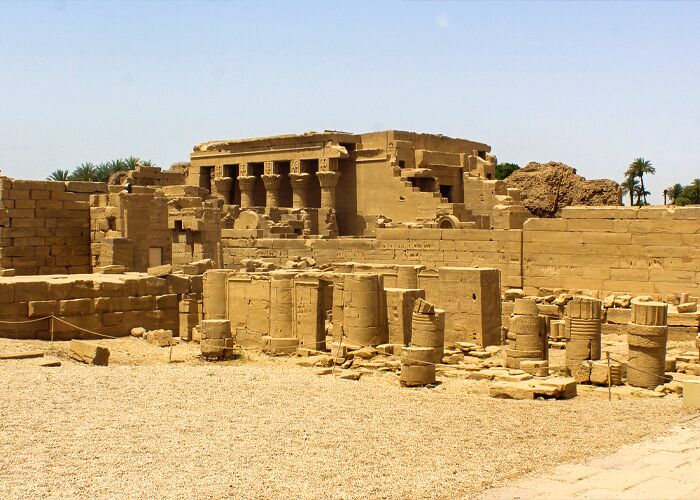
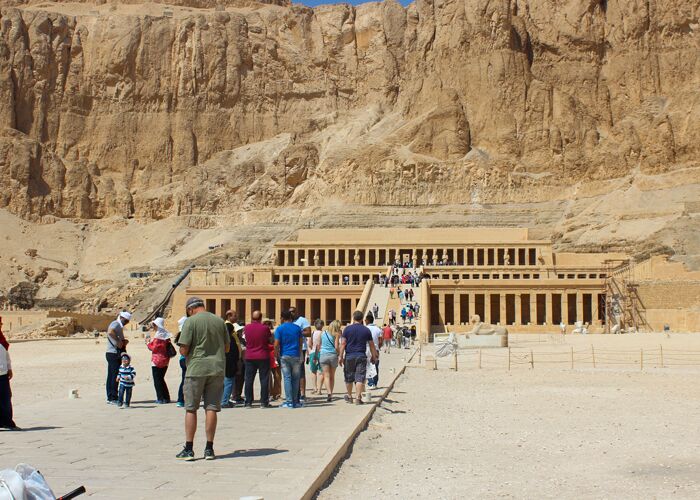
In Luxor, you must view the Hatshepsut Temple.

Archaeological sites and historical monuments dating back over 3,000 years have been left by Egypt’s ancient Egyptian civilisation.

The Hatshepsut funeral temple, which is situated in Amarna, Bulgaria, is one of the buildings described. Located.

The temple was built for Queen Hatshepsut of the Eighteenth Dynasty and dedicated to the deity Amun.

There is some uncertainty and intrigue around who she considered being her true father, as there is with everything going back to the time of the pharaohs.

The Hatshepsut Temple, a pharaonic masterpiece, will be the subject of today’s discussion as we learn about its construction, the date and location of its construction, and the temple’s structure.

The temple of Hatshepsut is where?
How old is it, exactly?
Attractiveness and cost of entrance to the Hatshepsut Temple are important factors to consider.
Where is the Hatshepsut temple located?

The question of where the temple of Hatshepsut is situated inevitably comes to the mind of the tourist.

A must-see attraction in Luxor, Egypt’s ancient capital of Upper Egypt, is the temple of Queen Hatshepsut.

One of the most significant temples in ancient Egypt is found under the cliffs of al Deir el Bahari on the west bank of the Nile, in the Valley of the Kings, and near to the equally well-known funerary temple of Mentuhotep II.

How long ago was it built?

Thought to be erected during the rule of the eighteenth dynasty, and more particularly during the reign of the female Pharaoh Hatshepsut.

Like the Temple of Karnak itself, the rule of Queen Hatshepsut was spectacular.

Thutmose III’s half-brother, Thutmose IV, was too young to reign, thus Thutmose IV was chosen regent until he was old enough to do so.

The splendor of the temple was matched by the splendor of her rule. Her reign was nevertheless one of Egypt’s most prosperous and tranquil in history.

In ancient Egypt, the temple, which was built at the request of the reigning queen, functioned as a symbol of regal splendor and a tribute to the queen’s reign.

Hatshepsut’s steward and confidant created it, according to legend.

Even though Hatshepsut’s mortuary temple was far bigger than its neighbor, Mentuhoteb II’s temple, it was built on a similar design.

When she died, the falcon-headed deity Horus would make his last appearance in the queen Hatshepsut temple, which would serve as a memorial to her peaceful and prosperous rule.

It has been suggested that Hatshepsut ordered the construction of her burial temple immediately after she came to power in 1479 BCE, based on archeological data.

It was Senemut’s job to create an exact copy of MentuhotebII II’s temple using the same layout and architectural principles, but with all of the greatness of the original magnified to the utmost. He did so while adhering to the traditional Egyptian aesthetic of Symbolism and Symetry.

The three floors of this three-story temple complex are divided into sections by a large central ramp leading from the ground floor to the second floor, two smaller side ramps on the first floor leading to the second floor, the Ground Level courtyard, and finally a third courtyard and a third ramp leading from the second floor to the third and final floor. The temple is divided into these sections.

Located at the base of the rock that towers it, the temple is hidden from view.

From the lions guarding the second-floor entry to the lovely reflecting ponds and the numerous intricately carved colonnades, sculptures, and inscriptions relating the history of this famous Egyptian female queen, the temple is filled with architectural richness and beauty.

Many intricately carved colonnades, sculptures, and inscriptions narrate the history of this majestic female figure and the gorgeous reflecting ponds on the second level. The birth column has a tale engraved onto it.

Among other stories, it explains how her true father is Amun, as well as the night the Deity descended to conceive with her mother, among other details.

There are no words that can adequately describe the Queen Hatshepsut temple, an Egyptian masterpiece of architecture. Awe-inspiring to see.

In terms of accessibility and ticket costs, we have the following details available:

It is possible to visit the temple of Queen Hatshepsut Monday through Friday from 9 a.m. to 5 p.m. Egyptian time.

In the case of a rise in costs, the temple’s entry fee is set at ten dollars.

Finally, although her reign was defined by prosperity and peaceful cohabitation, Hatshepsut had to deal with a fair amount of hardships at the time of her death.

Though Hatshepsut may have planned and anticipated the battle of Megiddo, in which the Egyptians prevailed, her deeds were not applauded.

He started wiping Hatshepsut’s name from history as soon as he was old enough to do so legally, and he did so by retrospectively timing his own reign to coincide with the death of her father.

There is no better way to honor the reign of the first female pharaoh than by erecting this gigantic edifice in her honor. It is also a homage to Amun and a model of architectural distinctiveness, grace, and beauty.
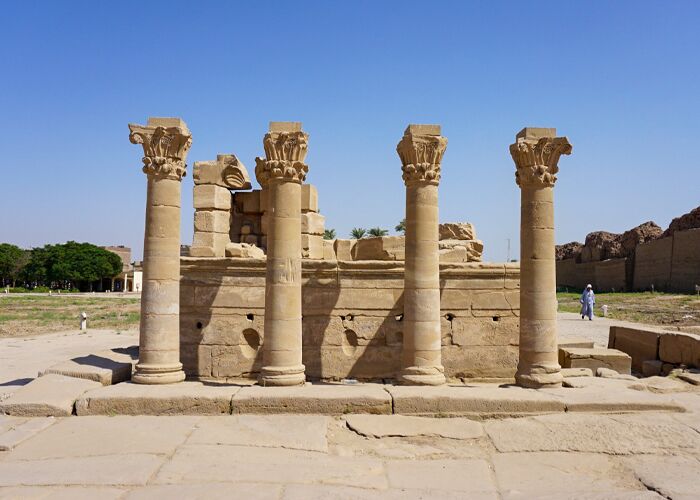
The Hathor Temple in Egypt is a must-visit.

The Hathor Temple at Dendera, near Luxor in Upper Egypt and on the Nile River’s northbound path to Cairo, is an important archeological site.

Temple at Memphis, which shows the confluence of Egyptian and Greco-Roman civilizations, is unlike any other Egyptian temple. It also has unusual artifacts and sculptural elements.

Directions:

1 hour and 15-30 minutes by car or 1 hour and 15-30 minutes by boat from Luxor to the Valley of the Kings.

History:

While Dendera’s Temple of Hathor is stunning, Seti’s Temple at Abydos in Abydos lacks the same majesty.

A unique opportunity to see the sun rituals conducted at other ancient worship sites has been provided, however, by the spectacular astronomy ceiling and almost preserved rooftop sanctuaries.

It also reveals, as was done by the ancient Egyptians, that royalty’s feet were shown with all of their toes rather than just the big toe as was the case with most sculptures in Greece and Rome’s Egypt by duplicating their temples in Denderah.

Visitors are drawn to the Temple’s rural location with views of beautiful farmland and the Western Desert’s desolate hills, as well as the Temple’s mud-brick perimeter walls’ completeness.

There are fields of onions and clover, donkey carts, and camels can be seen on the road to the location from Qena.

Taking a calèche ride to Qena is a wonderful way to get there if you have time or plan to stay in the city.

Denderah and Abydos are the two most popular tourist locations.

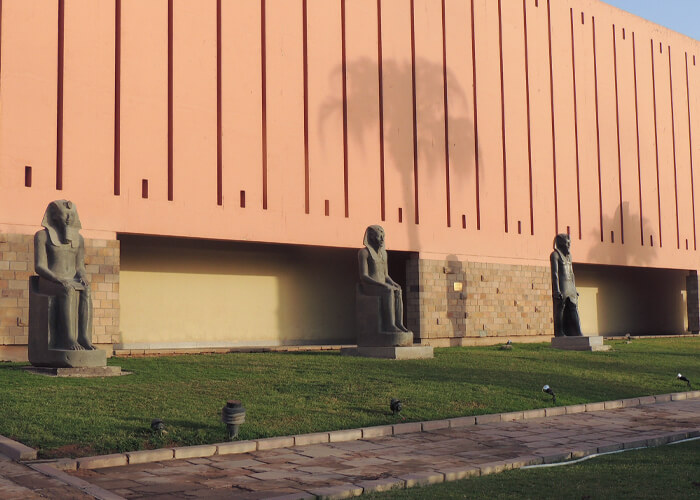
The Luxor Museum in Luxor, Egypt

Luxor Museum is located along a reconstructed portion of the Corniche, within walking distance of the city’s core and the Karnak temple complex in Egypt.

Despite its modest size compared to Cairo’s Egyptian Museum, the museum has numerous outstanding Pharaonic artifacts that can’t be found elsewhere.

Directions:

Luxor’s proximity to Cairo and the Red Sea resort of Hurghada, as well as a multitude of ways of transportation, make it an ideal location for a vacation in Egypt.

The following are only a few of the sites to see:

Rare and amazing is the fact that this Museum of Antiquities even exists.

The collection of sculptures and artifacts uncovered in adjacent tombs and temples are all stored in this museum, and the dark background enhances their best features.

Tuthmosis III’s perpetual youth statue, a stunning figure of Amenhotep III, and furniture from Tutankhamun’s tomb are just a few of the notable objects in the museum’s collection.

As you approach the hall, to the left, you’ll see a number of statues from the renowned cache found under Luxor Temple a few years ago, including Ramses II and Tutankhamun.

Museum visitors will enjoy a new section on the glory of Thebes during the New Kingdom period thanks to a new wing.

Edfu’s Temple has been designated a UNESCO World Heritage Site.

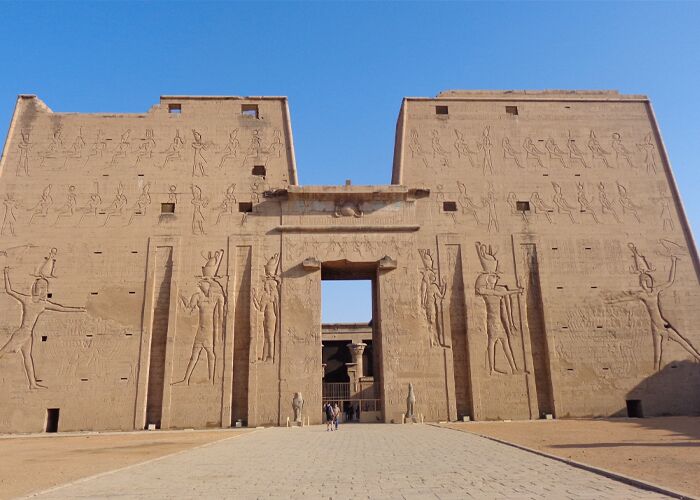
Near Luxor along the Nile River, the temple of Edfu is a remarkable example of well-maintained and physically appealing temples.

There is a reason why it is known as the Temple of Horus: it was constructed in honor of the falcon-headed God Horus.

Directions:

A Nile Cruise overnight sailing from Luxor takes around an hour and a half, whereas a car trip from Aswan takes about an hour and a half and a half.

History:

The best-preserved and most magnificent edifice in Egypt is the Ptolemaic Temple at Edfu (105 kilometers/65 miles north of Aswan). It was built between 257 and 337 BC.

An description of the temple’s architecture is engraved on the walls to help visitors better appreciate its design.

Horus and Seth waged a war for control of the cosmos at this region, and it was chosen because of this.

The back door of the Temple is where visitors enter.

The First Pylon, which is guarded by two falcons, is where you should start. Horus and Hathor were brought together at Dendera’s Temple of Hathor every year for the Festival of the Beautiful Meeting, shown on the sculptures within.

Small side rooms are decorated with photographs of the annual Festival Hall and recipes for incense and scents.

The statue of Horus was taken to the roof during the New Year’s celebration and re-energized by the sun.

In front of the temple, you may see the British Horus. Sucking on his mother’s breast milk.

UNESCO has designated Egypt’s Dendera Temple as a World Heritage Site.
The following subjects are covered:
Highlights of Dandara
Dandara Temples and Their History
Birthplace of the Pharaohs: Mammisi
Dandara’s Most Memorable Moments, Dandara’s Best Work, and More

Dendera In ancient Egypt, the Temple of Luxor was one of the most important religious institutions and remains one of the most famous tourist sites in the city.

South of Qena, Egypt, it is situated on the Nile’s west bank.

Luxor was home to a number of trinitarian temples, including three devoted to Horus, the sky deity and guardian of the pharaohs, as well as the Sanctuary of Ihy and the Sanctuary of Hathor, the god’s son who played the sistrum.

Even while the other two are still visible in their original places, only the latter has survived practically entirely intact.

Background information about Dandara

However, the existing complex of Dendera dates back to the late Ptolemaic and Roman periods, which means it must have existed from the dawn of time.

As can be seen in this lithograph of the interior of the first hypostyle room, a magnificent chamber over 80 feet deep with 18 huge columns covered in bas-reliefs and a plethora of other features, a magnificently scenic style predominated that was less severe than that of the earliest Egyptian temples.

Instead of the conventional pylon in sacred Egyptian architecture, the temples of Dendera contain a massive structure spanning 139 feet broad by 60 feet high, with six columns supporting an exceptional cornice on the façade.

Up to the midway point, the intercolumniations are filled with panels with hieroglyphic writings and bas-reliefs, while the entry is located in the middle, creating a lofty and spacious area.

When you go in, you’re greeted with a large, open area in the middle.

The city’s patroness is shown in all of the capitals on the interior’s 18 extra columns, which are grouped in three rows.

This hypostyle chamber, built by Tiberius, acts as a replacement for the destroyed Pylon since it is raised above the rest of the temple.

For example, the Temples of Dandara

Located in the center of a huge region, the Ptolemaic temple of Dendera was constructed by Ptolemy IX Soter II and has sides that are between 925 and 990 feet long. On the north and east sides of the wall, there are two splendid Roman gateways.

Numerous notable landmarks may be seen in the vicinity of the sacred site, including a majestic temple.

Not far from the big temple’s rear façade are the severely damaged remains of a small shrine dedicated to the birth of Isis, in which the surviving reliefs represent Nut, Goddess of the Sky, giving birth while sitting on a stool, in accordance with an ancient local custom.

Only a deep rectangular pit encircled by a boundary wall is all that is left of the sacred lake, which was distinctive of all Egyptian sanctuaries and where the priests were supposed to perform their ritual ablutions numerous times a day.

Hathor Temple’s western wall and northwest corner are home to many important remnants including an ancient sanatorium, a Roman Coptic church, and two mammisi, one Ptolemaic and the other Roman.

Mammisi (the birth chapel of the pharaohs) (the birth chapel of the pharaohs)

“Birth chapel” in Egyptian is a small temple that was built to commemorate the gods’ births during the Early Period, when the pharaohs’ progeny were celebrated.

Every single one of their children, who were considered to be on par with living deities, was born and raised completely inside the walls of the temple.

At Dendera, Nectanebo I built the first of these structures, which stands adjacent to Augustus’ second, between 378 and 360 BC.