Nubian villages are well-known for being modest and tranquil locations, and the interior design of a typical Nubian house is no exception to this rule.
Aswan, Egypt, is home to a number of Nubian settlements.
A Nubian Village’s Appearance is one of the many topics that will be discussed.
What Is the Neighborhood Like in a Nubian Village?
You may participate in a range of activities at a Nubian Village
When visiting a Nubian Village, where can we stay?
The natural majesty of the Nile and the friendliness of the people of Aswan combine to make this a charming and beautiful city.
All visitors to this beautiful city have had the chance to visit a Nubian hamlet, interact with the locals, and take in the stunning view of the Nile from the village.
In the Nubian village in Aswan, you will be able to enjoy, have fun, and learn about Nubian culture and traditions while also learning about your own culture and traditions. This is an experience that should not be missed.
To travel to the Nubian Village on the west bank of the Nile, a speedboat ride from Aswan’s tiny harbour to Soheil Island would be the most practical option.
Relaxing as it may be, it is also an excellent way to get a taste of the river’s pure air, which may be particularly refreshing in the heat of Aswan.
As an alternative to using public transportation, you may either drive your own car or hire a taxi to take you there.
Directions:
Less than 10 minutes is all it takes to go from Aswan Center to Luxor or Cairo by boat, but a one-hour flight from Cairo takes three hours.
In a Nubian community, what kind of life do you lead?
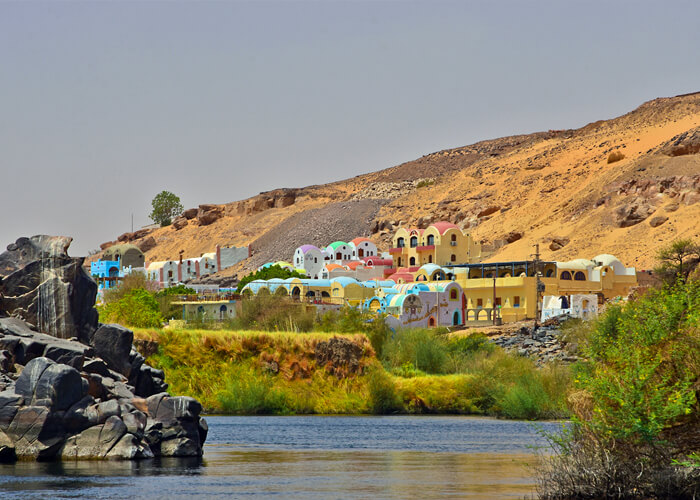
Upon entering the hamlet, you will see a variety of vividly coloured houses built in the Nubian manner utilising mud bricks composed of clay, water, hay, and sand as a binding agent.
Because they are all natural, these products are less likely to spread disease inside the house and are also more affordable.
In addition, heat has little effect on the texture of the bricks’ clay.
The dome-shaped ceilings of each house are designed to spread the sun’s heat throughout the inside of the structure.
They also prefer to decorate their houses with simple but pleasant colours and forms from their cultures like boats, camels, and palm palms that they typically sketch on the walls.
In a Nubian household, you will find nothing but decency, kindness, and a sense of belonging among the population.
We’re referring to the Nubians, a dark-skinned people recognised for their unique Nubian Language, which is different from and should not be confused with the Arabic language.
Nubian language non-native speakers aren’t given instruction on how to learn it, which is a fascinating aspect of the language.
As archery is the technique of using a bow to shoot arrows, the ancient Egyptians dubbed their land Nubia, which means “bow country,” because of this. For “land of the bow,” Ta-Seti is an acronym. For many Nubian rulers, archery was the most significant aspect of their military might.
Soldiers were buried with their archery equipment in their graves as a standard procedure.
Nubia was formerly a kingdom in southern Egypt and northern Sudan, located along the Nile and famous for its rich gold mines, according to historical accounts. The Nubians were also known as the Kush.
The interior style of a typical Nubian home follows suit with the village’s reputation for simplicity and serenity.
In contrast, the crocodile has been chosen to be the House pet, which is not to be afraid since they are maintained in enclosures.
Crocodiles, both live and mummified, are greatly prized and revered in Nubian houses.
Historically, the Nubian people have a unique affinity with crocodiles due to ancient Egyptian beliefs that crocodiles protect individuals and their homes from the Evil Eye.
Goats and chickens are just two examples of the more frequent animals you may see.
In a Nubian community, what kind of life do you lead?
Upon entering the hamlet, you will see a variety of vividly coloured houses built in the Nubian manner utilising mud bricks composed of clay, water, hay, and sand as a binding agent.
Because they are all natural, these products are less likely to spread disease inside the house and are also more affordable.
In addition, heat has little effect on the texture of the bricks’ clay. The dome-shaped ceilings of each house are designed to spread the sun’s heat throughout the inside of the structure.
They also prefer to decorate their houses with simple but pleasant colours and forms from their cultures like boats, camels, and palm palms that they typically sketch on the walls.
In a Nubian household, you will find nothing but decency, kindness, and a sense of belonging among the population.
We’re referring to the Nubians, a dark-skinned people recognised for their unique Nubian Language, which is different from and should not be confused with the Arabic language.
Nubian language non-native speakers aren’t given instruction on how to learn it, which is a fascinating aspect of the language.
The ancient Nubians were well-known for their skills in archery, which involves shooting arrows from a bow.
Consequently, the Egyptians referred to the region as “Ta-Seti,” which translates to “bow country.” For many Nubian rulers, archery was the most significant aspect of their military might.
Soldiers were often interred beside their archery equipment, as was customary at the time.
The kingdom of Nubia, located along the Nile in southern Egypt and northern Sudan and famed for its enormous gold deposits, was said to have existed, according to historical accounts.
The interior decor of a typical Nubian home is in keeping with the village’s reputation for being simple and peaceful.
Crocodiles are an unexpected option for a house pet, but they’re not dangerous because they’re housed in zoo cages.
Crocodiles, both live and mummified, are greatly prized and revered in Nubian houses.
Due to the ancient Egyptian belief that a crocodile’s presence would protect them and their homes from the Evil Eye, the Nubian people have an unique affinity for the reptile.
Goats and chickens are just two examples of the more frequent animals you may see.
A list of things to do when vacationing in a Nubian village
While visiting a Nubian city, you may want to go shopping for Nubian accessories, apparel, and bags at Nubian-owned establishments.
Visits to historical monuments and museums are other popular pastimes.
The bright colours and Nubian symbols on the outfit are sure to draw attention when you return home.
Instead, you may use cumin, cinnamon, curry, and other odd spices like chai tea.
Since Aswan is internationally known for its genuine spices, they are wonderful souvenirs to bring back from Nubia.
As you travel through these fascinating towns, you’ll pass a slew of exquisite cafés and restaurants, many of which provide breathtaking views of the Nile.
If you wish to pause for a drink and some rest & relaxation, you will locate lots of possibilities.
Camel riding is another exciting activity that you should try out while you are in the nation of Nubia.
Women and children may also take part in a wide range of exciting activities.
Many Nubian women in the hamlet use Henna, which they produce themselves from plants and oils, to decorate their bodies.
Many Nubian women participate in henna tattooing, which is a great example of such an activity.
While you’re in the vicinity, be sure to check out the Nubian Museum as well.
The artefacts on display here illustrate the Nubian way of life, including their tools and attire, as well as the many pursuits they took part in throughout time.
Additionally, artefacts from the villages’ Islamic, Coptic and Pharaonic periods are also on display, along with a few others from the vicinity.
The famous Egyptian singer Mohamed Mounir, whose family is from Nuba, has a palace in the Nubian hamlet where tourists may see it.
King Mounir (also known as King Mounir) wrote the vast bulk of his music, which is mostly performed in Nubian dialect.
For their lively songs and dances, the Nubian people are well-known across the world