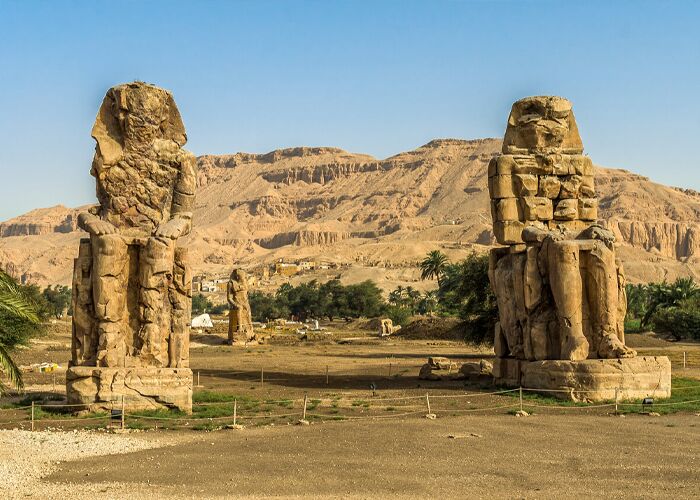
Colossi of Memnon, from the 18th Dynasty of ancient Egypt, are two giant ancient Egyptian statues of Pharaoh Amenhotep III (reigned 1386-1353 BCE). They show the king sitting above a seat of power topped with images of his mother, wife, the god Hapy, and other symbols and built with quartzite stones mined in el-Gabal el-Ahmar from the 14th century B.C. These statues stand watch over Amenhotep’s tomb. After being damaged by floods in Egypt, this vast form was finally abandoned and left in tombs.
Who is Memnon
Memnon was a hero at the time of the Trojan war. He was also the king of Ethiopia, and he led his soldiers across the continent of Africa and into Asia to defend the city that was under attack. Achilles was the one who ultimately put an end to his life. The two statues use the name “Memnonium” to refer to the whole of the Theban Necropolis, a name that has been used for more than 2,000 years.
Where did the name “Colossi of Memnon” come from?
The Colossi of Memnon are most commonly referred to by their Roman name, the Temple of Memnon, despite the reality that their ancient Arabic name is Kom el-Hatan. Memnon, king of Ethiopia, was a respected figure in the Trojan War. He led his army over the oceans from Africa to Asia Minor, where they tried to support the protection of the besieged city that Achilles was challenging. Although, Achilles utterly defeated Memnon and his army.
Memnon, whose name means the steadfast or determined, was the son of Eos, known for being the goddess of dawn. Memnon’s name means smooth or firm. Many years after the construction of the Colossi, Memnon became connected with the structure due to the cry at dawn given by the northern statue, also referred to as the “Vocal Memnon.” Memnon’s status as the “Ruler of the West” spread.
Description of Colossi of Memnon
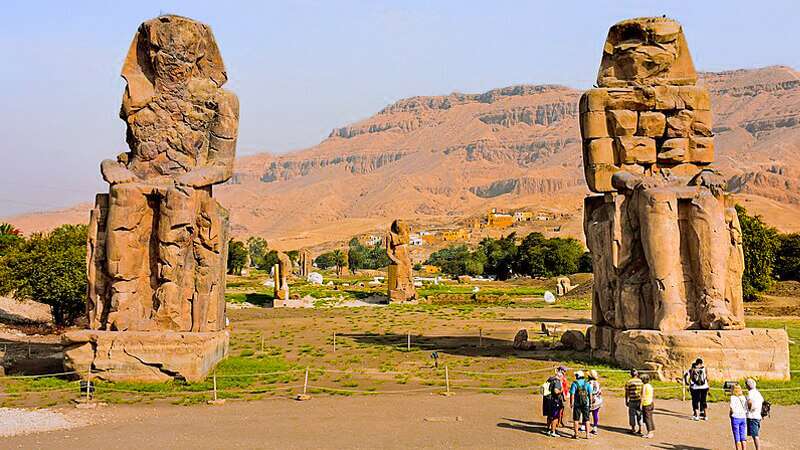
They stand at the height of 18 meters and weigh 720 tonnes each. Each one is hand-hewn from a specific piece of sandstone. They are statues of a pharaoh wearing the royal crown of the Nemes, followed by a divine cobra, and seated on a throne with such a second king. The king has his hands on his knees and is looking eastward towards the Nile River. His mother Mutemwiy and wife Tiye are shown as little figures on the front of the statues. Despite their silent decay, the two temples symbolize the unique Egyptian history and culture.
Where is the Colossi of Memnon located?
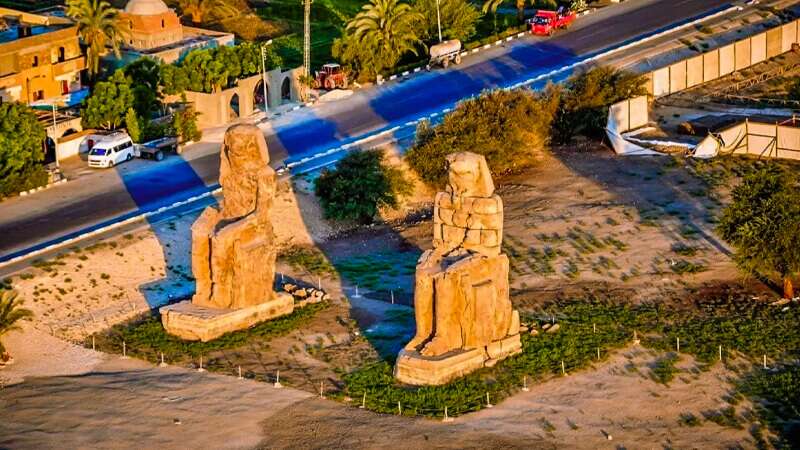
In the West Bank of Luxor, Egypt, there are gorgeous twin statues of Pharaoh Amenhotep III, as well as two more miniature sculptures carved by his feet; one of these statues symbolizes his wife, and the other reflects his mother. These statues stand graciously on the horizon of the magnificent Luxor distances.
The entrance to the mortuary temple of Amenhotep III is composed of statues, each of which is around sixty feet in height. They are known as the Colossi of Memnon because of an event with one of the statues following an earthquake, and this phenomenon gave rise to their famous nickname “.
The Colossi of Memnon are two giant statues made of quartzite sandstone. They were first built in the Theban Necropolis, located west of the Nile River in the modern city of Luxor. Archaeologists believe that the stone was quarried at El-Gabal el-Ahmar, located near modern Cairo, and transported 420 miles overland to the ancient city of Thebes.
When was the Colossi of Memnon built?
Pharaoh Amenhotep III ruled Egypt during the 18th Dynasty, usually from 1386 to 1349. The duration known as the Old Kingdom in Egypt included the kingdom of this Pharaoh and was marked by outstanding economic growth and significant cultural advancement. During the time of the Old Kingdom in Egypt, architectural work underwent a remarkable improvement, and the majority of the tombs that were built during this time are still functioning today.
During the 39 years that Amenhotep III served, many of these beautiful ancient sites were constructed, including the Colossi of Memnon, whose building was finished by 1350 BC. The Colossi of Memnon was built in front of the area formerly possessed by Amenhotep III’s temple (destroyed by an earthquake soon after its completion). The Amenhotep Temple was used as a tomb for Pharaoh Amenhotep III during his reign. During the time of the Roman Empire in ancient Egypt, the Colossi of Memnon was primarily damaged by an earthquake in 27 B.C., which led to their future repair by Roman emperors.
The legend of the “Vocal Memnon.”
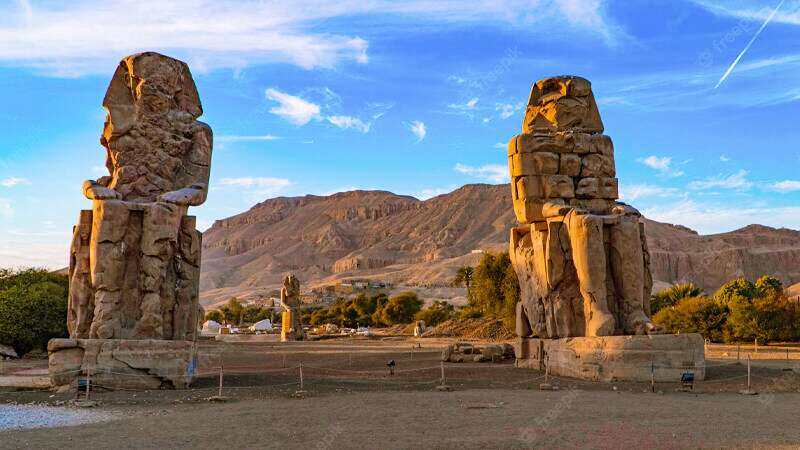
Due to an earthquake in 27 B.C., the northern Colossus was damaged entirely, collapsing from the waist up and breaking the bottom half. After this occurrence, the fragments of the north of Colossus that were left started to “sing” about an hour before sunrise, right when the sun began to rise.
The sound was believed to have been heard most usually between February and March; however, this may have been because this was when the most significant number of people visited the statues. When the Greek historian and geographer Strabo heard the sound during his visit to the Colossi of Memnon in 20 B.C., he described it as a “blow.” Strabo listened to the sound during his visit to the colossi.
According to an urban legend, those who took the time to listen to the strange sound made by the “Vocal Memnon” were said to be gifted with good fortune. This legend spread beyond Egypt’s borders, resulting in an increasing number of travelers from other countries, including several Roman emperors, who were looking for the blessing that the “Vocal Memnon” could provide.
Since it grew in popularity, many people in history and even in modern times have been supposed to solve the case of the “Vocal Memnon.” As such, to this day, no explanation has been known, and the “Vocal Memnon” is going to be one of the many mysteries surrounding the ancient Egyptian civilization.
What impact did the Colossi of Memnon play in ancient times, Protectors of the Gate?
The Colossi of Memnon was playing the functions of a temple guard just at Amenhotep III Temple. The Colossi of Memnon was built with the idea of protecting the temple of Pharaoh from evil. When a powerful earthquake fell on the temple, the Colossi of Memnon stood indifferent for thousands of years.
AMENHOTEP III AND THE great Empire Of EGYPT
Pharaoh Amenhotep III lived in Egypt during the New Kingdom, which lasted from 1570 to 1069 B.C., and was defined by the increase of Egypt to a position of international power and luxury. So he was just twelve years old at the time, and his father lost him a successful empire. He wed Tiye, who became known as the “Great Royal Wife” after they were united in marriage. Even Amenhotep’s mother did not receive this title, which is a reflection of the queen of Pharaoh Amenhotep and his wife Tiye as married couples. He had a beautiful vision of the area, which can be seen via the 250 buildings, temples, steles, and statuaries that he completed during his great royal reign. This vision can be seen in the land. The palace at Malkata, which is situated on the western bank of the Nile in near Thebes, is an idea of one of his fantastic palaces. This magnificent location includes a huge number of rooms, as well as a festival hall, gardens, a large number of libraries, kitchens, conference rooms, and the Temple of Amun.